Tuesday, March 19, 2013

El Salvador Mission Trip 2013

Before the trip….


I was praying for doctors and nurses. We had only 2 doctors – Yakub Elias and myself. We had only one RN I knew of, on the team. We had a few ER techs and nursing students, CNAs.

Day 1 in El Salvador – January 20, 2013

We arrived safely. On board the plane ride to El Salvador from Chicago, one of our team members passed out. She became cold and clammy. It was touch and go for a bit. However, she held on. It was probably a combination of being awake, on her feet and exhausted. She did okay.
Chatting with Richard Pickrell -- our worship pastor at the airport in Chicago on the way

We went through customs without a hitch. However, we were told the bad news: the customs officer would keep our medicine bags. Apparently, the processing of documents that would allow us to bring the medications into the country was not complete. The medications were therefore to be left there until the paperwork could be completed. Since we arrived on a Sunday, nothing could be done that day.

The Castillo del Rey bus that took us around El Salvador

Happy to be back in El Salvador -- loading up luggage from the airport


a 'tower' of medicines ready for clinic the next morning

at the airport at San Salvador, waiting for our ride
In the evening, we sat and counted out tablets and poured liquid medications (we had sent an order of medications that was delivered from Europe to King’s Castle and this was what we had to work with). We wondered if it would be enough. I discovered that 2 nurses that had come with a team before us had stayed behind to work with us. One of them – Mary flushed ears all day and the deaf could hear after she was done!

Day 2 – January 21, 2013 – First day of work


After a 2.5 hour drive to Miraflores, El Salvador (picture), we set up clinic in the church. We saw 158 people there. A mother brought in a toddler with a fever of 104. We were able to treat this child with an antibiotic and brought her temperature down to normal.


She was playful when she left. We saw 10 dental patients and gave out 45 pairs of eyeglasses.

Day 3 – January 22, 2013 – Second day of work

We worked out of the gym in Lago Coatepeque that day. I was nervous because we were already low on medicines (not having what we had brought down from the States yet). We saw 182 patients this day. I gave a walker to an 103 year old male (picture) who took off.

103 year old man with his new walker
We saw a 44 year old female with a piece of sewing needle stuck in her hand for 7 months. Dr. Elias removed it. My last patient of the day was a 12 year old female that had been sexually abused for 4 months. Mom wanted a pregnancy test. She was not pregnant but did have symptoms consistent with a sexually transmitted disease. We treated her and she received counseling. Yakub’s last patient was a 4 year old boy with seizure-like spells. He too had been abused when he was younger. He was on 3 different classes of medications for seizures but his EEG was negative. We prayed for him. We saw 15 dental patients and gave out 76 pairs of eye glasses.


Planning the day with Tammy, one of the local missionary nurses from Castillo del Rey

Our dentist, Andrea McNeely, assisted by Richard Pickrell
Our meds arrived! Our whole team worked hard to count them up and have them ready for the next day. It was great team work!

Day 4 – January 23, 2013 – Third day of work

We worked out of the gym again. We saw 191 people that day. One of them was an 11 month old boy that was severely dehydrated with a high fever, diarrhea and a rash. We were able to get an IV started and treated him with fluids. We saw 14 dental patients and gave out 78 pairs of eye glasses.

I LOVE working in medical missions!

Guadalupe is a small town we passed on the way

Day 5 – January 24, 2013 – Fourth day of work

We got in the bus and drove about 2 hours to San Juan Miraflores Abajo, in the same municipality as Miraflores. We saw 143 patients. Patients here asked about diabetes, cholesterol and weight. One patient wanted to know if the vitamins I was giving her would make her fat. Several patients had blood sugars in the 500s. Dr. Yakub sort of yelled at one woman to be more careful with her diet and she recommitted her life to the Lord in counseling after that. Another complained that her son would not eat regular food, but would eat pizza and burgers just fine. We saw 12 dental patients here and gave out 59 pairs of eye glasses.

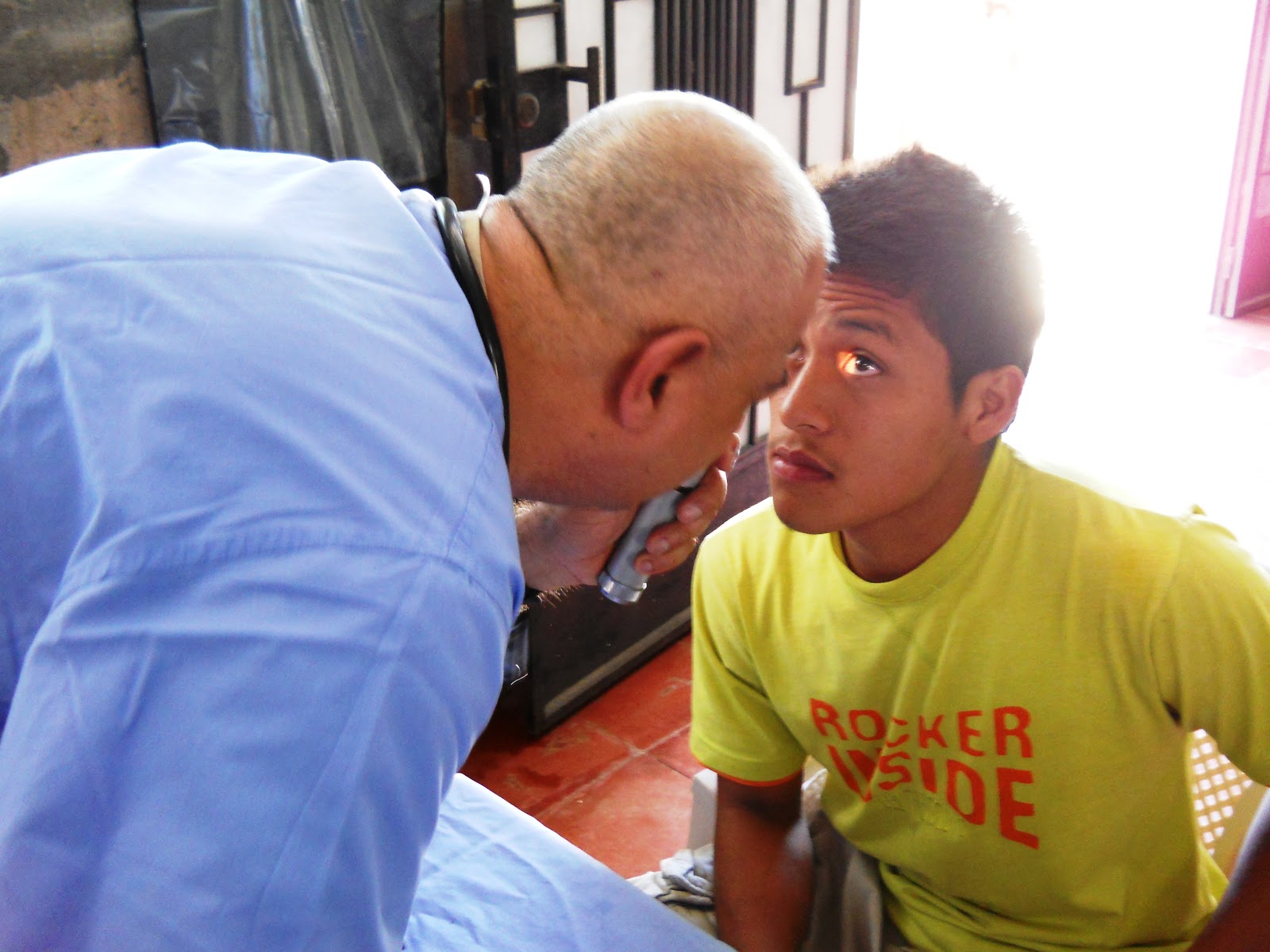
Examining the eyes of a young man

Hands - a little girl's hand in mine

A cheloid on the ear of a teenager, came from wearing an earring on her pinna
a skin rash on a middle-aged man -- I suspect ichthyosis

the rash was on both the upper and lower extremities


A close up of the rash on the lower extremity

Day 6 – January 25, 2013 – Last day of work

the portable dental suction unit our dentist uses

Our dentist had all her instruments set out daily for the work ahead

Hands - our dentist holding some of the infected teeth she extracted.
We drove to Nueva Esperanza (about an hour away). We saw 266 patients here. There were a lot of young mothers – 13 through 18. Dangerous place: girls are lifted out of the classrooms by gangs and no one does anything. We treated one 4 month old baby with a severe staphylococcus infection. We saw 19 dental patients and gave out 88 pairs of eye glasses.

Why do we give out glasses? (Picture 1 of eye) – because sun damage causes pinguecula that progresses to (picture 2 of eye) pterygium, that causes blindness. Only surgery can remove this growth once it forms.

pinguecola -- spreading from the medial canthus towards the pupil

Pterygium -- the growth now covers the pupil in this older woman
All told, we saw 940 medical patients, gave out 346 pairs of eye glasses and treated 70 dental patients. With only 2 doctors and not having our US meds for 2 of the 5 days, we still saw more patients than we have in each of the past 3 years. The LORD knew how to space us out with our meds and he gave us grace to serve. In the end, we had enough doctors, 4 awesome nurses who did excellent work and many, many helpers in the medical work. Everyone pitched in to count meds and load the buses each day.

from left to right: Drs Yakub Elias, Vijay Aswani and Boris Magana

Nail disorder in an older woman

assymmetric enlargement of right lobe of thyroid

Vitiligo patch on knee of a teenage boy

vitiligo patch on the back of neck of the same teenage boy

I suspect Buerger disease in this unfortunate lady, who has had bilateral above the knee amputations due to poor circulation and now has decreased circulation in her fingers.

Listening to the lungs of a man complaining of cough

Dr. Elias checking ocular movement and cranial nerves in a young lady

100 people who came to the medical work accepted Christ.

On the last day, I was discussing why so many people in the sites where we saw patients get intestinal parasites. We were discussing how we might improve sanitation and drinking water. One of the missionaries that was there this year holds a Masters in Environmental Engineering from Johns Hopkins and was with Engineers without Borders. He is going to work on setting up an appropriate technology solution.

We plan to work on educational materiel to teach basic hygiene, sanitation.

Oscar.

Last year, at Nueva Esperanza, I got to see a paraplegic who had the worst pressure sores I had ever seen (picture of buttock sore). Working under less than sterile and optimal conditions, with Terry Martin as a nurse to assist, I debrided his wounds. He told me they healed and closed us on their own (picture of healed sores).

Sacral and buttock ulcers before debridement last year

This year, most of the ulcers have healed up well!
We gave him a wheelchair cushion and a mattress.

This is a picture of the mattress we got Oscar. His little nephew stands nearby

Oscar with his mom, a nephew and a niece in his house.
This time, I was able to go to his house and see where he lived. Here are the pictures. For someone in a wheelchair, he lives in a dirt floor house with boulders in the driveway.

the floor of Oscar's house

Oscar lives in poverty, the only breadwinner in his home being his sister. She works in a Fruit of the Loom factory in El Salvador making mens underwear (check the labels on yours, if you wear FotL).

The dirt flooor of Oscar's home is readily visible in this picture

and in this one

This is Oscar's driveway that turns to mud in the rains.
During rains, it turns to mud. He is unable to leave his room to go to his sister’s room next door because of a step-down into her room. We would like to put a floor in his house, level his driveway and put cement over it. This will cost $ 1200. We have someone reliable who is presently there and can help.

Update on the Clinic

The clinic is coming along nicely and God willing, should become operational before the year is out. We need money or airconditioning, electricity and supplies within the building. Here are some pictures.

Outside the clinic... I swear the wind was blowing through my shirt... I am not that fat!

The inside of the clinic near the receiving entrance. The floor has been laid down and there are now windows and doors in place

Our dentist with Dr. Boris in a proposed work area.


Birthday cake

I was working Urgent Care one weekend. It was almost the end of the shift, and being a Sunday, most of us were looking forward to going home to enjoy the rest of the day. Suddenly, we were informed that a family of 5 were checking in! It appeared that they were all at a birthday party and had eaten cake. When Mom was washing the knife they had used, she noticed a piece of it was missing. Of course, everyone's concern was that perhaps someone had ended up eating a piece of cake with a piece of knife in it. There were also several people checked in on the adult's side of urgent care (I was working on the Peds side).

Usually, we would get x-rays to look for the 'foreign body'. Fortunately, an astute x-ray technician (who also probably wanted to go home) asked if we could x-ray the cake instead. As it tunred out, the family had brought the knife (what was left of it) and the cake. Here is what we saw:
tray of cake -- can you see the knife piece?
How about now?
The piece missed what was missing from the knife. Not only was everyone relieved, but this x-ray technician saved several people including children from having to be exposed to the radiation of x-rays.

There was only one problem: how do you record the images in the radiology software system? To whom should the bill go to?

Thursday, December 20, 2012

Treatment Dilemma

What would you do? I have a patient that has a chronic disease. This disease causes him to get lung infections and shortness of breath. In order to manage the disease (there is no cure yet), he needs to perform certain treatments at home on a daily basis. Unfortunately, he does not. Consequently, he ends up in the Emergency Department with symptoms of shortness of breath and signs of lung infection. I am usually called to admit him to the hospital. He usually ends up staying 14 to 18 days, during which he gets the treatments he should have been doing at home, gets IV antibiotics and an intensified treatment plan to treat the acute exacerbation of his disease.

While in the hospital, he is quite comfortable. He is watching tv, eating well, likes to keep the room very cold, stays up late at night and sleeps in, in the mornings. His social situation is that he lives with a significant other who has teenage kids. The house is noisy, not very clean and there is a competition for the food in the fridge. In the hospital, these problems do not exist for him.

From a physician's standpoint, I feel unable to turn away a sick patient who, without treatment could have a very serious outcome (eventually death). From the standpoint of being a steward of our healthcare resources (did I mention that he is on state insurance?), I almost feel like I should turn him away and figuratively, give his bed to someone else who will be more committed to doing the home treatments as they should. On one hand, I completely sympathize with the patient: having a chronic disease that requires a burden of treatment every day, in spite of which life will be shortened by the inexorable course of the disease is a hard reality to bear. Which of us do 'the right thing' every single day? Many people eat unhealthy, do not exercise, or smoke. Would we (or the healthcare system) punish them? At the same time, at what point do we withhold treatment from someone for not doing the right thing? Some healthcare providers 'fire' their patient. Lung transplant units will refuse to put someone on the list for a lung transplant (even if they need it) if they do not feel the person will make the necessary lifestyle changes (such as quitting smoking). These are harsh decisions made by stewards of limited resources (like a donated lung).

What would you do?

Friday, November 30, 2012

The Two Sides of Medicine

Last week, I got to attend a lecture by a PhD who has developed some revolutionary tools in medicine. He talked about the various 'omics' -- genomics, proteomics, metabolomics and others that I had not even heard of. He talked about new technology that could measure as little as 300 molecules of something in a body fluid. Back in the day when I went to graduate school, we had learned about Moles, millimoles, micromoles as the smallest quantities of something. Apparently, there is now a picomole and a femptomole (which I have heard of) but also an atomole and a zeptomoles -- newer units of measurement to keep pace with a technology that can measure them.

He spoke of a day within, say, the next 20 years when we will be able to wave a wand instrument in front of a patient and get measurements of key molecules in their system to tell us what the probability will be that they will get this or that cancer, or whether they are infected with that or that virus.

For a while, I felt I was watching star trek or some other futuristic science fiction show, as he showed us slides of the technology, the results and its potential. It was truly amazing.

Of course, at the end of the presentation, I went back to my clinic where in an examining room I used my rubber tube filled with air with a flat plastic and metal disk which I placed on my patients' chest and back to listen to their heart and lungs to make a diagnosis.

I find it curious and sometimes get culture shock when I go between the world of the future with these promising new tecnologies and the world of primary care in underserved areas where basic healthcare is still an unobtained goal. Oh Well.

Sunday, July 29, 2012

Autopsy

Yesterday I had a strange new experience as a doctor. I have been taking care of a young (30s) man with spina bifida for the past 5 years. I had just seen him for a physical recently. A few minutes before leaving the clinic at the end of a busy day, I received a phone call from a pathologist. My patient, who I will call Steve, was found dead in his apartment. The cause of death was not known. An autopsy would be performed. I was stunned. I had just seen him a few days ago and things looked good. He had a chronic urinary infection, but with his neurogenic bladder and paraplegia, this was not new or unexpected. He was on prophylactic antibiotics for this. I asked when the autopsy was planned for and was told it would be done the following morning. Since I was not scheduled to work or be on call that day, I asked if I could attend. The autopsy was to be performed in another town.
Yesterday morning, I drove there and found the morgue. Present was the pathologist who would be doing the autopsy, the county coroner and a med tech. I was permitted to gown up and assist with the procedure.

It was a somewhat surreal experience to be standing before someone I had known and cared for for several years and had just examined a few days ago. He lay dead on the autopsy table. The autopsy proceeded in the usual fashion with a Y-shaped incision made on the chest. The ribs and clavicles were sawed to permit up to lift up the rib cage. Systematically, heart and lungs were removed and examined. Bowels were removed and examined. Liver and gall bladder were removed and examined. When we came to the urinary system, the cause of death became apparent. The right kidney was grossly enlarged with a large extra-renal pelvis. There was frank pus in the bladder. The cause of death was urosepsis. It was estimated that Steve had been dead for at least 24 hours before he was found in his apartment. Interestingly, a nurse from the clinic had called him in the morning to give him some normal lab results and his mother spoke to him at around 3 pm that afternoon. He must have died within 6 hours of that time. There was no warning. It is unusual for urosepsis to set in so rapidly with no symptoms manifesting even 6 hours before. Some element of mystery will always remain.

I called his mother from the morgue with Steve's splayed open body still on the table. She had come to his appointment with him as she usually did, just 4 days ago. I offered my condolescences. I said goodbye to Steve and walked away.

In one sense, it was interesting to see the very organs I had palpated, auscultated and percussed from the outside while he was alive. I was able to hold and touch the kidneys and lungs and other diseased organs. I was able to see his spinal fusion beneath the scars I had seen just 4 days ago. In another sense, it was sad -- I was looking at and in his corpse. As primary care providers we do not have to go to autopsies. I went because he was my patient and I wanted as much as anyone to know why he died and as my final act of care. Goodbye Steve. You died so young! I will miss you!

Monday, July 16, 2012

Camp Angel - Summer 2012


Fort
Camp Angel is a camp held twice a year (summer and winter) for children touched by cancer through a family member. Camp Angel 2012 was held at its usual summer location: Camp Luther, Three Lakes, WI (http://www.campluther.com/) from July 13 to 15, 2012. If you have never been to Camp Luther in beautiful Three Lakes, it is worth checking out the pictures of Camp Luther at their website. Especially beautiful and I think, unique are the actual camp sites where the campers spend their nights. 
Noah's Ark

Pioneer Village or Covered Wagons
Towers
51 kids showed up this year. They were divided into our usual 4 groups, the 14  littler girls (7-9 year olds) were in the Bunnies group and they stayed at the Pioneer Village or Covered Wagons. The 16 older girls (10 and 11 year olds) were in the Foxes group and stayed at the Treehouse. Similarly, the 9 littler boys (7-9 year olds) were in the Wolves Group and stayed in the Tower, while the 12 older boys (10 and 11 year olds) were in the Bears group and stayed at the Fort. The photos show pictures of the Covered Wagons, Treehouse, Tower and Fort camp sites where the groups stayed.

The campers arrived at about 3 pm in the afternoon on Friday, July 13. After some games of introduction, campers went to their respective camp sites to settle in. We had our usual Friday night dinner of delicious pizza. This year, something was different. We should have known, given it was Friday the 13th. There was quite a storm during dinner and lightening cracked a tree that fell on a powerline pole and took the powerline down with it. One of our camp staff whose was driving in late was stranded on the other side of the blocked road. Also unable to get through to us was the local Harley Davidson Group. No one was hurt. We did lose power though. One enterprising biker was able to get through and he generously offered to present a show-and-tell to the kids. Practically every kid got their picture taken sitting on his bike! The camper retired to their camp site for the night where they slept…er…played and horsed around.
The downed power line

The next day, power was restored by around 7 am. After breakfast, in 2 separate groups, we took off for Eagle River where we went for a ride on the Pirate Ship (http://www.eagleriverpirates.com/index.html). 

Captain Steve was gracious as ever. We had a great time (aarrrhhh!!!). We came back hungry and ate a great lunch. After lunch and swimming tests, it was time to get out on the water. Kids swam, went tubing, swung from the rope into the water, fished (actually caught fish!). On shore, there was face painting, rock painting, crafts, painting driftwood and other fun activities. In the evening, DJ Dan brought his setup over and it was time to dance! This year, there were many requests for Justin Bieber. DJ Dan did not disappoint. Even though he did not have any to begin with, thanks to the internet and iTunes, kids were soon rocking to Bieber. Kids returned to their camp sites for bonfires, s’mores and (officially this did not happen) girls versus boys camp raids.
Beware the pirates!
Okay. So this is a medical blog. As the camp doctor, I treated small cuts and bruises. I did have to set and cast one displaced fracture for one little girl. Nothing serious. She came to me in tears with her broken walking stick. She left smiling with her stick bandages and set (almost) as good as new.

I treated some swimmers ear, upset stomachs, overheating, mild dehydration and the camp staple: homesickness. I also made sure everyone got their scheduled medications. I was a little uncomfortable given one little girl the medication that she was prescribed by her provider back home. Her medications included lithium (for bipolar disorder), Seroquel (for mood disorder), Depakote (for mood disorder) and something for sleep and ADHD. I am not a child psychiatrist. I felt sorry for this little girl being on such strong psych meds.
Free Style Four Squares: chicken feet, black magic and cherry bombs allowed!

Girl talk and ... hey, get off the roof!


Pirates of the Caribbean... okay, actually of Camp Angel

A sign in the pirate ship... hope the kids didn't notice!

Me and the First Mate

I LOVE Justin Bieber! Play more Justin Bieber!

Captain Steve made some mean tatooes...

Hanging on to the bobbing moon-thingie was loads of fun

Sliding into the lake

Our med and First-Aid room -- my kingdom

A view of the lake early in the morning

A shout-out to the awesome camp counselors we have. These young men and women, many of whom began coming as high school students and some of whom still come even though they’ve graduated college do a great job. They are aces at treating homesickness and worshipped by their campers. They carried them, played with them, colored T-shirts with them, and made the camps fun for these kids.

The camp is kept short – three days because most of these families have too much going on to spare their kids for longer. Reading through each child’s connection to cancer breaks your heart. There was one little boy at camp with his two sisters. 


He constantly acted up. Playing Four Squares, he would argue about the rules (black magic and chicken feet allowed/not allowed, we’re playing freestyle versus we’re playing four squares). Reading his notes, I realized that he and his three sisters had lost their dad about a month ago to cancer, and he was really close to him. What’s more, his death had been difficult. Childhood should be a happy time. Cancer does not respect that. Camp Angel brought smiles and laughter to broken hearts, even if just for a weekend. Every little bit helps. Hopefully, we created some sunshine memories in the dark cancer-winter  of these young lives. 

Tubing. Go faster!